OEM Brand Couplers vs EH Interchange Parts: Which One Actually Fits, Lasts and Costs Less?
OEM Brand Couplers vs EH Interchange Parts: Which One Actually Fits, Lasts and Costs Less?
Quick Answer
An EH interchange coupler delivers the same ISO interface and fit as the OEM brand part at a lower landed cost, but the warranty and documentation are not identical. Choose OEM when the machine is under factory warranty or the part is safety-critical and audited; choose EH interchange when the interface standard matches and you can verify the part number yourself.
- Fit depends on the ISO standard and thread, not on the brand printed on the body.
- OEM protects factory warranty; EH interchange protects your unit cost and lead time.
- Verification takes 10 minutes with a caliper and the OEM part number.
In This Guide
- What really differs between an OEM brand coupler and an EH interchange part
- Does an interchange coupler really fit my machine?
- Which coupler standards can be cross-referenced safely?
- How does the warranty position differ in practice?
- What does the cost comparison look like at 100 units?
- When should you stay with OEM?
- How to verify an interchange part in 10 minutes
- Which EH interchange series matches your OEM part
Every week a maintenance planner faces the same question: the OEM dealer quotes a coupler at four times the price of the aftermarket offer, with a two-week lead time, and someone has to decide whether the cheaper part is safe. The decision is usually made on price or on fear, and both are the wrong basis. What decides the outcome is the interface standard, the thread, the seal material and the warranty chain — four checkable facts.
This guide walks through those four facts using real part numbers from the EH HYDRAULIC range, so you can compare an OEM brand coupler and an EH interchange part on the same terms. Nothing here replaces the OEM service manual. It replaces the guesswork.
1. What Really Differs Between an OEM Brand Coupler and an EH Interchange Part?
An OEM brand coupler and an EH interchange coupler are not two different products. They are two supply routes to the same interface. The coupling geometry, the valve design and the thread are fixed by the standard — ISO 16028 for flat face, ISO 7241-A and 7241-B for poppet types, ISO 5675 for agricultural breakaway couplers. Any coupler that meets that standard must mate with any other coupler that meets it.
What genuinely differs is everything wrapped around the metal: who signs the warranty, who controls the drawing revision, how long the part takes to arrive, and what documentation ships in the box.
The four real differences
- Commercial chain. An OEM part carries the machine builder's margin, dealer margin and regional distribution cost. An interchange part carries the factory's margin and freight.
- Traceability. OEM couplers usually ship with a batch number tied to a machine serial. Interchange parts ship with a factory batch number tied to a material lot.
- Warranty path. An OEM warranty claim runs through the dealer network and can be bundled with a machine-level claim. An interchange claim runs through the coupler supplier and covers the coupler alone.
- Revision control. If the OEM changes the internal valve or seal, the part number changes and you are told. An interchange supplier must track that change themselves.
The practical consequence is that fit is rarely the risk and commercial exposure is. A well-run interchange programme treats the coupler as a specified component with a part number, a standard and a verification step — not as a commodity bought on the lowest quote.
2. Does an Interchange Coupler Really Fit My Machine?
Fit is decided by three measurements and one number: the standard, the body size, the thread, and the OEM part number you are replacing. If all four line up, the coupler fits. If any one is wrong, no brand name will save the connection.
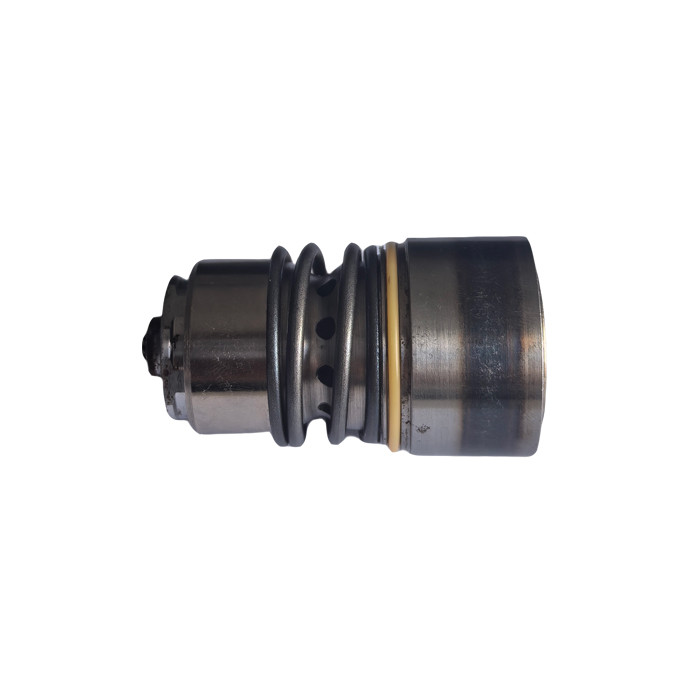
Take a John Deere SCV breakaway coupler as an example. The machine needs a breakaway that releases at a defined pull force, reseats without tools and holds system pressure without weeping. The EH equivalent supplied against the RE577560 interface is built to that same geometry, in steel, with a serviceable internal assembly. That is why it can be listed as a direct replacement rather than a "similar" part.
Measure before you order
- Body size. Measure the coupler body diameter with a caliper. Common flat face sizes step at roughly 1/4 in, 3/8 in, 1/2 in, 3/4 in and 1 in.
- Thread. Identify NPT, SAE ORB or BSP before anything else. A 1/2 in NPT port and a 1/2 in BSP port look close and seal differently.
- Valve type. Flat face, poppet or breakaway. Mixing a flat face half with a poppet half never seals, regardless of size.
- OEM number. Copy the number from the machine parts book, not from the old coupler body — the body may already carry an aftermarket marking.
| Criterion | OEM brand coupler | EH interchange coupler |
|---|---|---|
| Interface standard | ISO 16028 / 7241-A / 7241-B / 5675 as built by the OEM | Same standards, matched to the OEM interface by part number |
| Fit verification | Dealer confirms by VIN or serial | You confirm by part number, body size, thread and valve type |
| Typical unit cost | Highest — includes OEM, dealer and distribution margin | Lower — factory price plus freight |
| Lead time | Often quoted in dealer backorder weeks | Stocked SKUs ship from inventory; custom parts 35–45 days from drawing approval |
| Warranty | Bundled with the machine warranty through the dealer | Coupler-only warranty through the supplier |
| Documentation | OEM parts book reference and dealer invoice | Factory batch, material lot and inspection record |
| Revision control | Controlled by the OEM | Controlled by the interchange supplier against the OEM number |
| Best use case | Machine under factory warranty or safety-audited | Out-of-warranty fleets, replacement programmes, dealer stock |
Read Table 1 as a risk map rather than a price list. The OEM column concentrates risk on the supplier; the interchange column distributes it back to you. That trade is worth making when you have the measurement discipline to verify the part and the volume to justify the savings.
3. Which Coupler Standards Can Be Cross-Referenced Safely?
Cross-referencing is safe where the standard fixes the mating geometry and the supplier documents the match. It becomes unsafe where the OEM adds a proprietary feature — a specific breakaway force, an integrated pressure relief, a custom seal stack, an anti-rotation key — that the standard does not describe.
Standards with reliable interchange
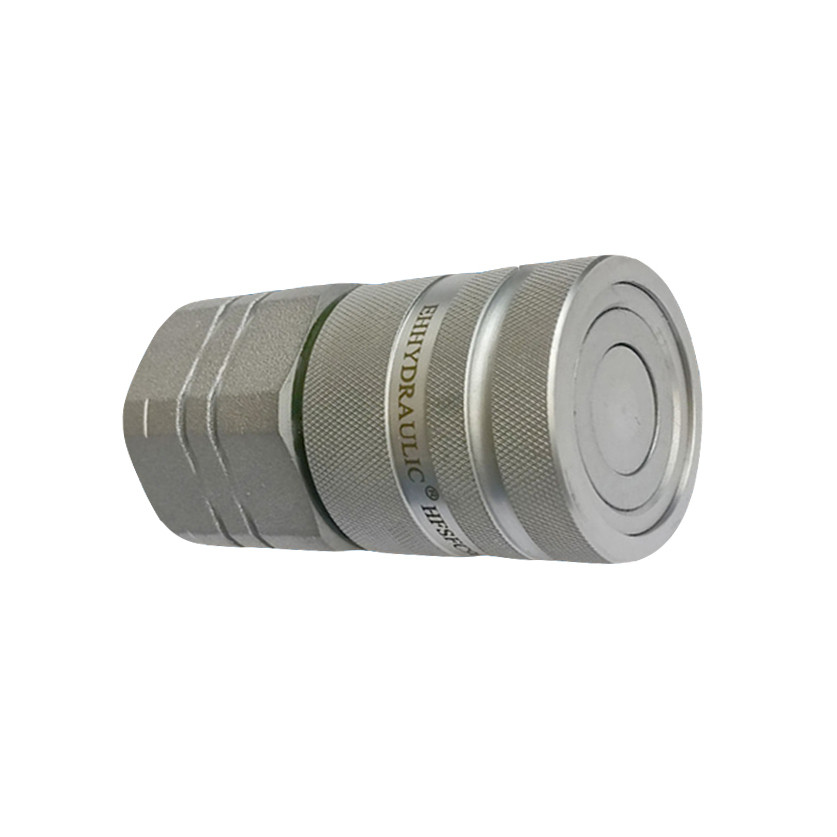
- ISO 16028 flat face. The mating face, seal pocket and locking ball arrangement are fixed. Interchange across brands is routine, which is why flat face couplers are the most common substitution in skid steer and mini excavator fleets. Read more in our guide to ISO 16028 flat face hydraulic couplers.
- ISO 7241-A. Poppet valve, widely used on agricultural and utility equipment. Cross-reference is reliable when the thread and body size match. See the ISO 7241-A quick coupler range.
- ISO 7241-B. Higher pressure poppet design, common on the PARKER 60 Series interface. The ISO 7241-B quick couplers page lists the matching series.
- ISO 5675. Agricultural breakaway, fixed release geometry. Substitution is standard practice across tractor fleets; see the ISO 5675 agricultural couplers.
Where cross-reference needs care
- Breakaway force. Two couplers can share an interface but release at different pull forces. If the OEM specifies a force, ask for it in writing.
- Seal material. NBR, FKM and EPDM cover different fluids and temperatures. A correct fit with the wrong seal still fails — usually within a month.
- Integrated relief or sensing. Test point couplers and multi-coupling plates often carry functions beyond the standard. Verify port by port.
If you cannot confirm one of these points from the supplier's documentation, you are not buying an interchange part. You are buying an experiment.
4. How Does the Warranty Position Differ in Practice?
Warranty is where most sourcing decisions quietly go wrong. Both routes offer a warranty. What differs is what the warranty covers, who decides, and how long a claim takes to resolve.
What an OEM warranty actually covers
An OEM coupler claim is normally attached to the machine claim. The dealer inspects, files the claim and replaces the part. If the failure is judged to have been caused by a non-OEM component elsewhere in the circuit, the claim can be refused as a whole. That risk is real but narrower than it is often described — it applies mainly to machines still inside the factory warranty window.
What an interchange warranty covers
An interchange warranty covers the coupler and its workmanship. It does not cover the hose, the machine or lost production. The claim route is direct: supplier inspection, batch trace, replacement. For a fleet outside factory warranty, this is the only warranty that exists anyway.
There is one more consideration that rarely appears on a quote sheet: if a coupler fails and causes a hose burst, the cost is not the coupler. It is the fluid, the cleanup, the downtime and sometimes an injury report. That is why the verification step in section 7 matters more than the price difference in section 5.
5. What Does the Cost Comparison Look Like at 100 Units?
Unit price is the easiest number to compare and the least informative. Landed cost is what the finance team actually pays, and it changes the ranking quickly once freight, buffer stock and downtime are included.
The three cost lines that move
- Unit price. This is where the OEM route is clearly more expensive, and where the visible saving is generated.
- Buffer stock. A long lead time forces you to hold safety stock. Carrying 100 units you do not need for three months is a real cost, even if the invoice was cheap.
- Downtime. An unavailable coupler can stop a machine for a day. One day of a mid-size excavator usually exceeds the price difference on a hundred couplers.
| Parameter | OEM brand part | EH interchange part | What to verify |
|---|---|---|---|
| Interface | ISO 16028 | ISO 16028 | Mating face and seal pocket |
| Body size | 1/2 in | 1/2 in (EH 96 Series) | Caliper measurement |
| Thread | NPT or SAE per parts book | NPT or SAE option | Thread gauge |
| Rated working pressure | Per OEM specification | Per ISO 16028 series rating | Supplier datasheet |
| Seal material | Per OEM specification | NBR standard, FKM on request | Fluid and temperature range |
| Body material | Steel, zinc plated | Steel, zinc plated; stainless option | Corrosion environment |
| Serviceability | Seal kit from dealer | Serviceable assembly and seal kit | Rebuild interval |
| Lead time | Dealer backorder dependent | Stocked, or 35–45 days custom | Written delivery date |
| Warranty | Via machine warranty | Coupler-only | Claim terms in writing |
The indicative figures above are the parameters that decide a substitution, not a quotation. Always confirm working pressure, seal material and thread against the machine parts book before committing to a batch, and treat any number the supplier cannot document as unverified.
How the calculation usually lands
For an out-of-warranty fleet replacing 100 couplers a year, the interchange route typically wins on unit price and buffer stock, and the OEM route wins on nothing except claim convenience. For a single machine still under factory warranty, the OEM route usually wins because one refused claim can cost more than the entire saving across a hundred parts.
6. When Should You Stay With OEM?
There are situations where the badge on the coupler body is worth the premium, and pretending otherwise is how sourcing advice loses credibility. Four of them are common.
- The machine is inside the factory warranty window. Any substitution gives the dealer a reason to dispute a later claim, even on an unrelated component.
- The coupler carries a safety function. Breakaway couplers on loaders and lifting equipment, and couplers in a safety-audited circuit, are usually best kept to the OEM part unless the substitution is approved in writing.
- The OEM uses a proprietary feature. A specific release force, an integrated relief, or a sensing port can be outside the standard and outside what an interchange supplier can document.
- The fleet is small and the stock is not managed. If nobody measures and nobody verifies, the cheaper part becomes the more expensive mistake.
For everything else — out-of-warranty machines, dealer stock, replacement programmes, rental fleets and OEM production where you are the brand — the interchange route is a normal engineering decision rather than a compromise. That is also the route explored in our EH interchange guide.
7. How Can You Verify an Interchange Part in 10 Minutes?
Verification is not a leap of faith and it does not require a test bench. It requires the right four numbers and a supplier who answers questions in writing.
- Minute 1–3: get the OEM number. Use the machine parts book or the OEM number printed on the original coupler, not the number on a previous aftermarket replacement.
- Minute 4–5: match the standard. Confirm the coupler is ISO 16028, 7241-A, 7241-B or 5675, and that the supplier names the same standard for the replacement.
- Minute 6–7: measure the body. Caliper the body diameter and the thread. A 1/2 in body with a 1/2 in NPT thread must be replaced by the same pair, not a 1/2 in body with BSP.
- Minute 8–9: confirm the seal. Match seal material to fluid and temperature. Standard NBR covers most mineral oil circuits; FKM is the usual choice for higher temperature or specific fluids.
- Minute 10: ask for the record. Request the batch number and the inspection record in the quotation. A supplier who cannot name a batch cannot support a warranty claim.
- OEM part number copied from the parts book
- Standard confirmed on both sides in writing
- Body size measured, not assumed
- Thread type identified by gauge
- Seal material matched to fluid and temperature
- Delivery date and batch traceability in the quotation
If your coupler is hard to connect or already leaking, the problem may not be the part at all. Two of our most-read diagnostics are why hydraulic couplers are hard to connect and trapped pressure in hydraulic lines — both cheaper to read than to replace.
8. Which EH Interchange Series Matches Your OEM Part?
EH HYDRAULIC, a hydraulic quick coupler manufacturer based in Ningbo, has built couplers since 2004 and supplies interchange parts against the interfaces most common on construction, agricultural and utility equipment. The range is organised by series so a part number can be traced to an interface rather than to a sales conversation. Every series is listed with the OEM interface it matches, which is what makes the cross-reference checkable rather than verbal.
Series mapped to the interfaces you replace
- EH 96 / 95 / 296 / 297 Series — ISO 16028 flat face, supplied against the STUCCHI A, FIRG, APM and VEP interfaces. Start with the Flat Face ISO 16028 coupler range.
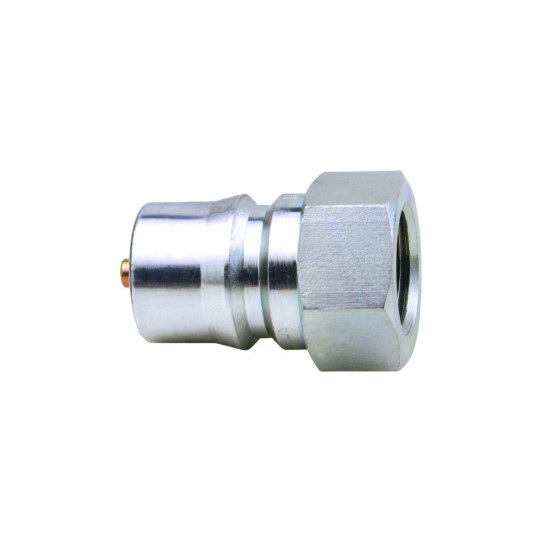
- EH 82 / 75 / 76 / 66 Series — ISO 7241-B and 7241-A poppet, including the PARKER 60 Series, HANSEN HA15000 Series and STUCCHI I-IP interfaces.
- EH 200 / 202 Series — CEJN 525 style with pressure elimination.
- EH 70 Series — RE577560 John Deere SCV breakaway coupler, plus the wider John Deere replacement coupler range.
- Brand replacement programmes — Kubota, Bobcat and CAT replacement couplers.
As EH HYDRAULIC, a hydraulic quick coupler manufacturer, we run production on a 22,000 m² factory holding ISO 9001 and ISO 14001 certification, with more than 3,000 SKUs and stock held for fast shipment. Custom and OEM/ODM parts are quoted from drawing approval, with a 35–45 day lead time as the normal planning figure. Couplers are supplied to distributors, rental fleets, maintenance providers and OEM builders — including the end users and maintenance providers covered on our industry end user and maintenance provider page.
For equipment that runs in mixed fleets, standardisation is usually the bigger saving. If you are consolidating several brands onto one interface family, the audit process in our hydraulic coupler standardisation audit and conversion plan is the place to start.
Frequently Asked Questions
Is an EH interchange coupler the same as the OEM part?
Will fitting a non-OEM coupler void my machine warranty?
How do I know which OEM number an EH part replaces?
Can I mix an OEM half with an EH half on the same connection?
What is the typical lead time for a custom interchange coupler?
Does a cheaper coupler really cost less over the year?
Match a Part Number Before You Order
Send us the OEM part number, the body size and the thread from your parts book. Our engineering team will confirm the matching EH series, the seal option and the delivery date in writing.
Contact Us View Flat Face Range